UseR 2025 - Duke
Duke University
parsermdimplements a C++ parser and abstract syntax tree (AST) for Quarto and R Markdown documents in R.
supports manipulating ASTs (filtering, editing, etc.)
nodes classes use S7 for validation and dispatch
ability to directly source and render ASTs
off-and-on project since covid, original use case was to aide in the grading for a large machine learning course
v0.1.3 is on CRAN, v0.2.0 with full Quarto support on GitHub (CRAN soon*)
Quarto examples today, but everything works with RMarkdown
hello.qmd---
title: "Hello, Quarto"
format:
html:
self-contained: true
---
```{r}
#| label: load-packages
#| include: false
library(tidyverse)
library(palmerpenguins)
```
## Meet Quarto
Quarto enables you to weave together content and executable code into a finished document.
To learn more about Quarto see <https://quarto.org>.
## Meet the penguins
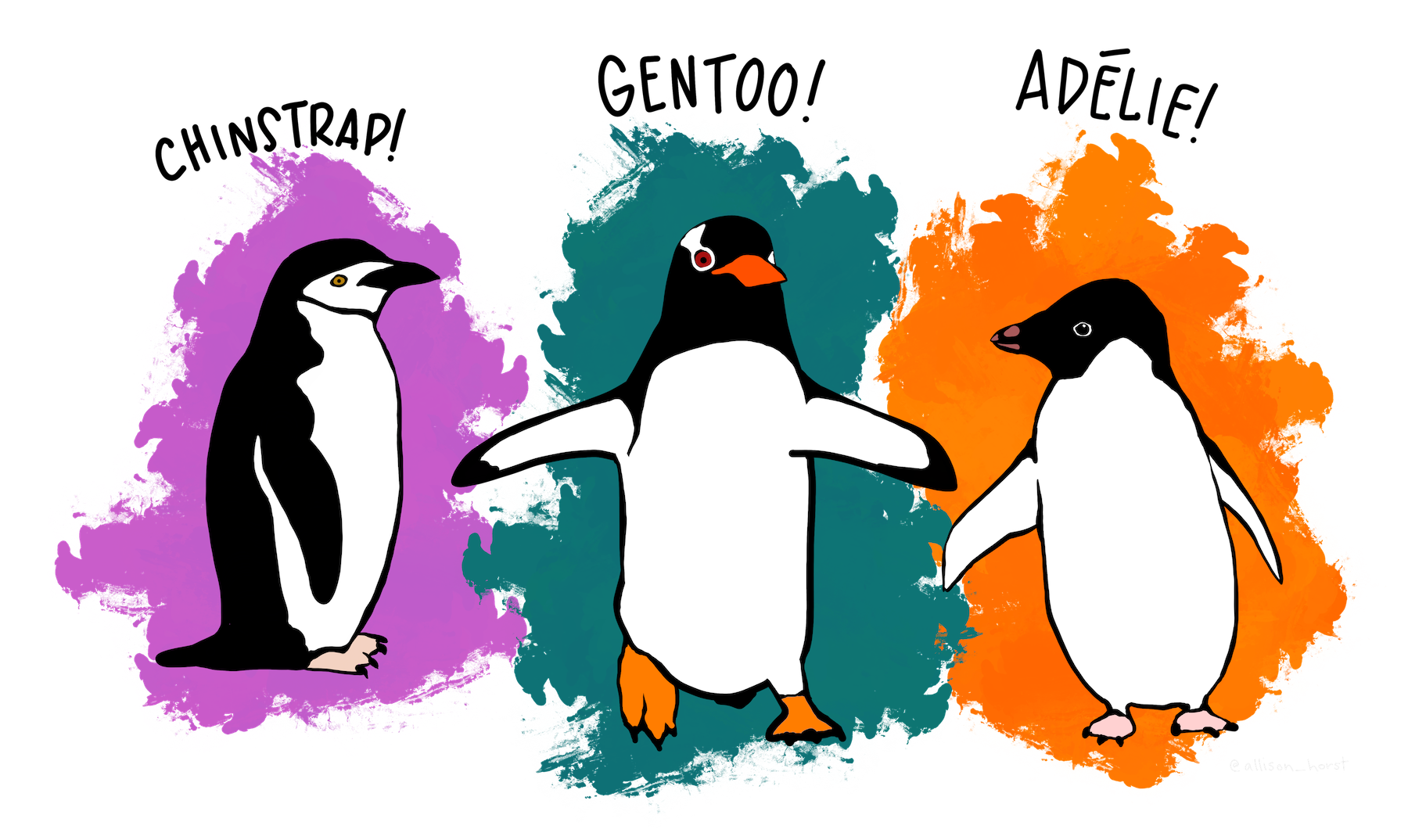{style="float:right;" fig-alt="Illustration of three species of Palmer Archipelago penguins: Chinstrap, Gentoo, and Adelie. Artwork by @allison_horst." width="401"}
The `penguins` data from the [**palmerpenguins**](https://allisonhorst.github.io/palmerpenguins "palmerpenguins R package")
package contains size measurements for `{r} nrow(penguins)` penguins from three species
observed on three islands in the Palmer Archipelago, Antarctica.
The plot below shows the relationship between flipper and bill lengths of these penguins.
```{r}
#| label: plot-penguins
#| warning: false
#| echo: false
ggplot(penguins,
aes(x = flipper_length_mm, y = bill_length_mm)) +
geom_point(aes(color = species, shape = species)) +
scale_color_manual(values = c("darkorange","purple","cyan4")) +
labs(
title = "Flipper and bill length",
subtitle = "Dimensions for penguins at Palmer Station LTER",
x = "Flipper length (mm)", y = "Bill length (mm)",
color = "Penguin species", shape = "Penguin species"
) +
theme_minimal()
```
## Other Quarto features
### Fenced divs
:::{.callout-note}
Note that there are five types of callouts, including:
`note`, `tip`, `warning`, `caution`, and `important`.
:::
### Markdown code blocks
Some sample python code,
```python
import numpy as np
import matplotlib.pyplot as plt
r = np.arange(0, 2, 0.01)
theta = 2 * np.pi * r
fig, ax = plt.subplots(
subplot_kw = {'projection': 'polar'}
)
ax.plot(theta, r)
ax.set_rticks([0.5, 1, 1.5, 2])
ax.grid(True)
plt.show()
```
### Short codes
Shortcodes are special markdown directives that generate various types of content,
{{< lipsum 1 >}}├── YAML [2 fields]
├── Markdown [1 line]
├── Chunk [r, 4 lines] - load-packages
├── Heading [h2] - Meet Quarto
├── Markdown [1 line]
├── Heading [h2] - Meet the penguins
├── Markdown [7 lines]
├── Chunk [r, 12 lines] - plot-penguins
├── Heading [h2] - Other Quarto features
├── Heading [h3] - Fenced divs
├── Open Fenced div [.callout-note]
├── Markdown [2 lines]
├── Close Fenced div
├── Heading [h3] - Markdown code blocks
├── Markdown [1 line]
├── Code block [python, 12 lines]
├── Heading [h3] - Short codes
└── Markdown [3 lines]├── YAML [2 fields]
├── Markdown [1 line]
├── Chunk [r, 4 lines] - load-packages
├── Heading [h2] - Meet Quarto
│ └── Markdown [1 line]
├── Heading [h2] - Meet the penguins
│ ├── Markdown [7 lines]
│ └── Chunk [r, 12 lines] - plot-penguins
└── Heading [h2] - Other Quarto features
├── Heading [h3] - Fenced divs
│ ├── Open Fenced div [.callout-note]
│ │ └── Markdown [2 lines]
│ └── Close Fenced div
├── Heading [h3] - Markdown code blocks
│ ├── Markdown [1 line]
│ └── Code block [python, 12 lines]
└── Heading [h3] - Short codes
└── Markdown [3 lines]Assuming a hierarchy lets us use a CSS selector like approach to target specific nodes based on headings and their descendants,
as_document()ASTs and nodes can be converted back to Quarto documents,
---
title: Hello, Quarto
format:
html:
self-contained: true
---
## Meet Quarto
Quarto enables you to weave together content and executable code into a finished document. To learn more about Quarto see <https://quarto.org>.rmd_select() and helpers are built using tidyselect (multiple selectors are or’d / unioned together)
by_section()
has_type()
has_label()
has_heading()
has_option()
has_shortcode()
by_fdiv()├── YAML [2 fields]
├── Chunk [r, 4 lines] - load-packages
└── Chunk [r, 12 lines] - plot-penguins├── YAML [2 fields]
├── Chunk [r, 4 lines] - load-packages
├── Heading [h2] - Meet Quarto
├── Heading [h2] - Meet the penguins
│ └── Chunk [r, 12 lines] - plot-penguins
└── Heading [h2] - Other Quarto features
├── Heading [h3] - Fenced divs
│ ├── Open Fenced div [.callout-note]
│ └── Close Fenced div
├── Heading [h3] - Markdown code blocks
│ └── Code block [python, 12 lines]
└── Heading [h3] - Short codes